

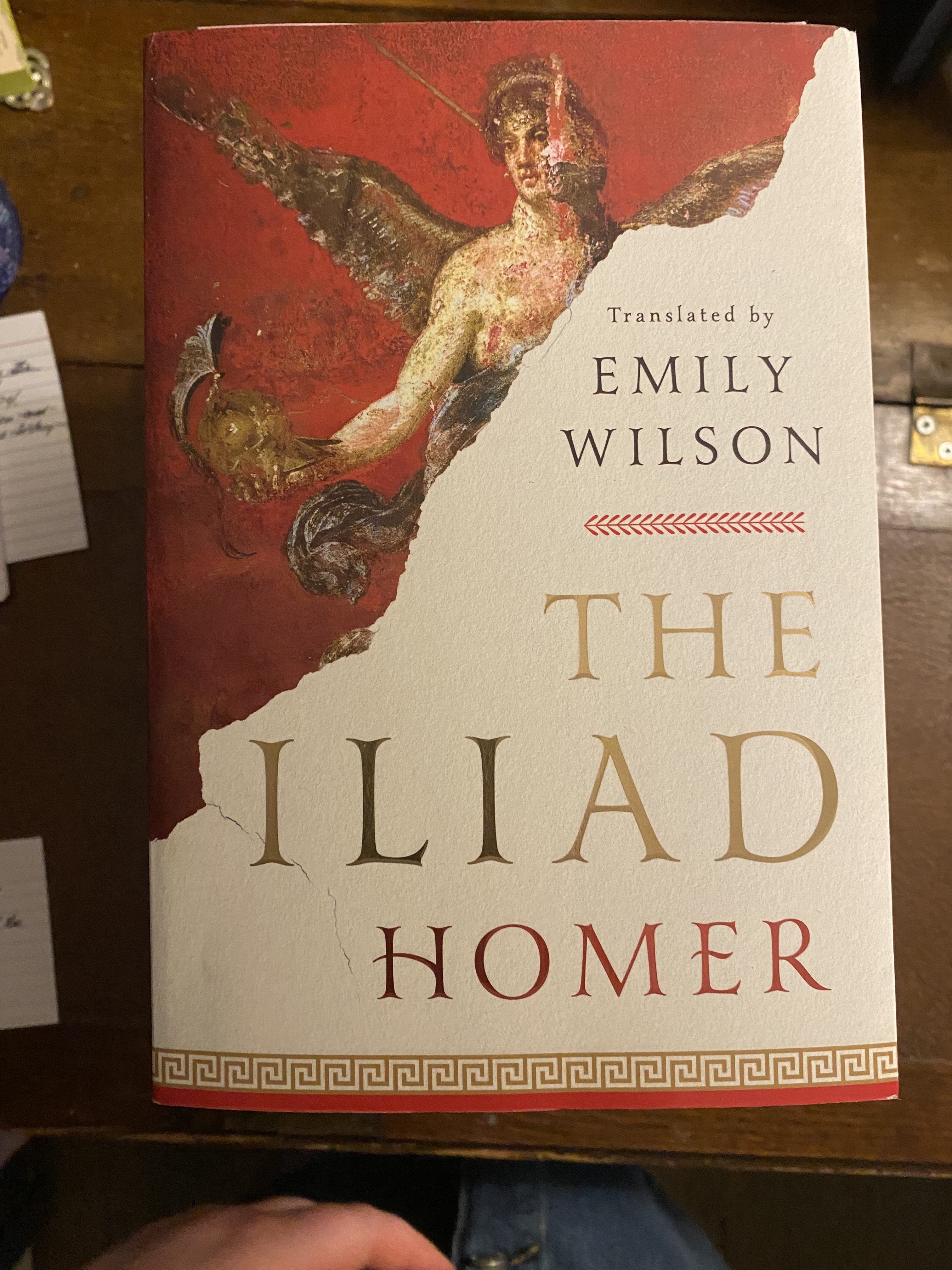

I wanted to take a slight step back this week from the discourse on Romance to focus on its literary precursor, the epic. If you get all your literature recommendations from social media, then the only two real examples you’ve seen of this art form are The Odyssey and The Iliad. These are not the only two, nor are they even the oldest. Both The Epic of Gilgamesh and The Mahabharata predate The Iliad.
Other epics, like Beowulf and The Nibelungenlied are known to be of ancient origin, but weren’t written down until much later. The Irish Tain is also in this category.
Granted, this is just a sampling of the epics that were eventually written down.
What the Epic Actually Is
As before, I went to the definition from the Holman and Harmon Handbook and have an excerpt from the longer definition for you below.
“A long narrative poem in elevated style presenting characters of high position in adventures form an organic whole through their relation to a central heroic figure and through their development of episodes important to the history of a nation or race.” (Holman and Harmon, 192)
This definition gives us a few clues as to what the epic is, and also what it isn’t. These works were there to transmit vital cultural information from one generation to the next in contexts where writing was scarce and almost certainly confined to a specific class of people.
Now, there is one specific point where the Holman and Harmon definition goes wrong and that is to assert that the “epic” is always a “long narrative poem.” This is almost universally true in the Western tradition, and in the Indo-European broader culture in general. But, it’s not the case globally. One notable exception is Japan’s Tale of the Heike which is written in prose, although I should note that it was performed rhythmically, much like you would a metered poem.
So, the epic is not always poetry, but when it is, we usually find it’s from a much older oral tradition. This is because poetry is nearly always easier to memorize than prose simply because of the rhythm. Memorization is not as central a part of education as it used to be, so modern readers and students aren’t as familiar with the benefits of poetry over prose.
Mainly, poetry provides a natural rhythm in the words which is easier to memorize than if you were to just write without any sense of rhythm at all. For English speakers, there are two basic natural rhythms that are almost peculiar to our language: iambic pentameter and alliterative verse. The first, some of you may remember (fondly or with dread) from when you studied Shakespeare, or you may have encountered it in Emily Wilson’s translations of Homer. This is a series of “feet” where one syllable is unstressed, the next stressed.
If you become fluent in this rhythm, you will even notice that it mimics your heartbeat.
Now, alliterative verse is something only scholars or readers familiar with Anglo-Saxon or Tolkien’s scholarly works know. This is the primary style of Beowulf and Morte Arthur (not to be confused with Le Morte d’Arthur). This focuses on specifically consonant sounds in specific places in each line. This is a form that is redolent across Northern Europe, particularly in Germanic and Scandinavian poetry, sometimes called galdur.
Of course, other national epics contain other meters, other rhythms, and other characteristics that are peculiar to the original languages in which they were written.
One other point I feel I should make here is that European, especially Northern European, epics are almost always in their native tongue and they are a starting point for literature in the vernacular or “vulgar” language. This is a direct contrast to Latin being the “official” language of Europe and the language used for most official legal documents into the modern age.
That alone should tell you something about the epic’s importance and why we should be careful about dismissing these as “nationalistic” without knowing or appreciating everything it entails. You can hardly call the court poet racist because people liked to hear about the exploits of someone from their own culture, and the epic was not a tool of the fundamentalist-style nationalism of the 1930s and 2020s that has everyone wary of the concept.
Why We’ve Ignored It
There are two primary reasons why the epic gets ignored in our modern culture: they belong to a class of narrative poetry, and they are associated with national heroic figures, national pride, and/or nationalism.
Poetic education has largely diminished to the study of lyric poetry, not narrative poetry. This means the epic often gets left behind on that basis alone because for contemporary readers “narrative” is almost always in the form of either the novel or the short story. Even the last vestiges of the epic that were nearly universal—Homer’s Iliad and Odyssey, are no longer as universal as they were even 20 years ago, let alone 10.
The epics that are in prose, like Tale of the Heike are considered “niche” or special interest subjects, not objects of universal education, and they tend to be ornate and dense in style which automatically puts them beyond reach for contemporary readers.
Cynicism regarding anything “national,” especially if its European in origin has also contributed to the epic being ignored. The majority of the general public, even if they are readers, cannot disassociate a piece of literature from the people who misread and misuse it for their own ideological or political agendas.
My recent article on The Nibelungenlied goes into this to an extent, since that particular epic was used by the Third Reich in some of the home-based propaganda, displaying the injured Germany as the hapless Siegfried, betrayed and stabbed in the back with a spear.
The issue is that by ignoring the epic, however “national” it may be—or not—we ignore a vital link in our common human heritage and an art form that laid the foundations for practically all the literature we have today.
In Western Europe, the epic was the basis for all literary endeavor. We have evidence, for instance, of Edmund Spenser citing his debt to both Homer and Virgil in a letter to Walter Raleigh, asking for him to endorse The Faerie Queene. This was deliberate, even if it was not entirely true. Spenser did draw on the epic as a general inspiration, but he didn’t copy much from either Homer or Virgil. His near contemporary, Roger Ascham, who I quoted in the last article I wrote, also falls back on Homer in his criticism of the many books of Italian literature that were circulating in Elizabethan society.
Like Spenser, Ascham has high regard ofHomer, even going so far as to call Odysseus the wisest man outside of the Protestant Biblical canon itself—something modern readers will dispute, I’m sure.
Why It Matters for Romance
It’s therefore logical that by studying the epic we end up, in some sense, studying the romance too. Romance, after all, is the successor to the epic and in some part inspired by the epic.
Many of the qualities and traits we have come to associate with Romance, whether that’s genre or otherwise, come from the epic tradition. The exploits of extraordinary and heroic figures who are aristocratic, and have some kind of prowess beyond the normal capabilities of their peers could almost describe any romantic protagonist. It could also refer to a person who acts the way we wished a similar person would act in real life, such as the love interest.
When we wish men in real life would be more like men in romance novels, we are unknowingly participating in the epic tradition to an extent. We want men to be better than they actually are in real life, we want them to be resourceful, capable, courteous.
There are other traits epics have that romances have picked up, the focus on cultural memory and the transmission of values that matter are more alive within the Romantic tradition, arguably, than they are in “serious literature.” From Ariosto’s Orlando which calls the glorious days of Charlemagne when the bulk of Europe was united under one crown, Anthony Hope’s Prisoner of Zenda that recorded the dying days of the leisure class and the values about action, honor, and duty that went with them, cultural memory has been more a trait of the romance than it has of anything else.
Cultural memory doesn’t always work when it’s realistic—that is more properly the territory of the chronicle, the historian, or the journalist. When we create memories of our culture we only really want to transmit and remember the good things and forget the less good.
The epic frames the less savory parts of life, like death on the battlefield, as part of some greater, more glorious action: this isn’t a denial of the reality of battlefield death, but a softening of it with fantasy mixed in. For instance the men in The Iliad have divine help every other page, or that everyone eats enormous amounts of meat in The Odyssey.
The presence of a treasure trove in The Nibelungenlied that never loses value no matter how much is spent or given away is pure wishful thinking, and the endless parade of new clothes would be equally at home in a modern Romantasy.
But when food is scarce, mostly grain or legume-based, and when gold is not something that is natural to your part of the Rhine, those fantasies say as much about a culture as anything else. What speaks to an audience’s desires says as much about the times in which they lived, as any archeological find can.
Today, we look at Romantasy books like A Court of Thorns and Roses and its sequel A Court of Mist and Fury, and what makes these books so popular is what is so blatantly being dismissed by groups like the manosphere, the new and severely downgraded Turning Point USA, the women who get up and say they shouldn’t be able to vote: marriage as a partnership that results from trust and friendship, and marriage as a relationship where dreams both shared and individual are made possible.
This is the legacy the epic has given us, writ large on Booktok bestsellers and New York Times lists, given back to us in stories that entertain today as surely as their forbears entertained our ancestors.

Leave a Reply