

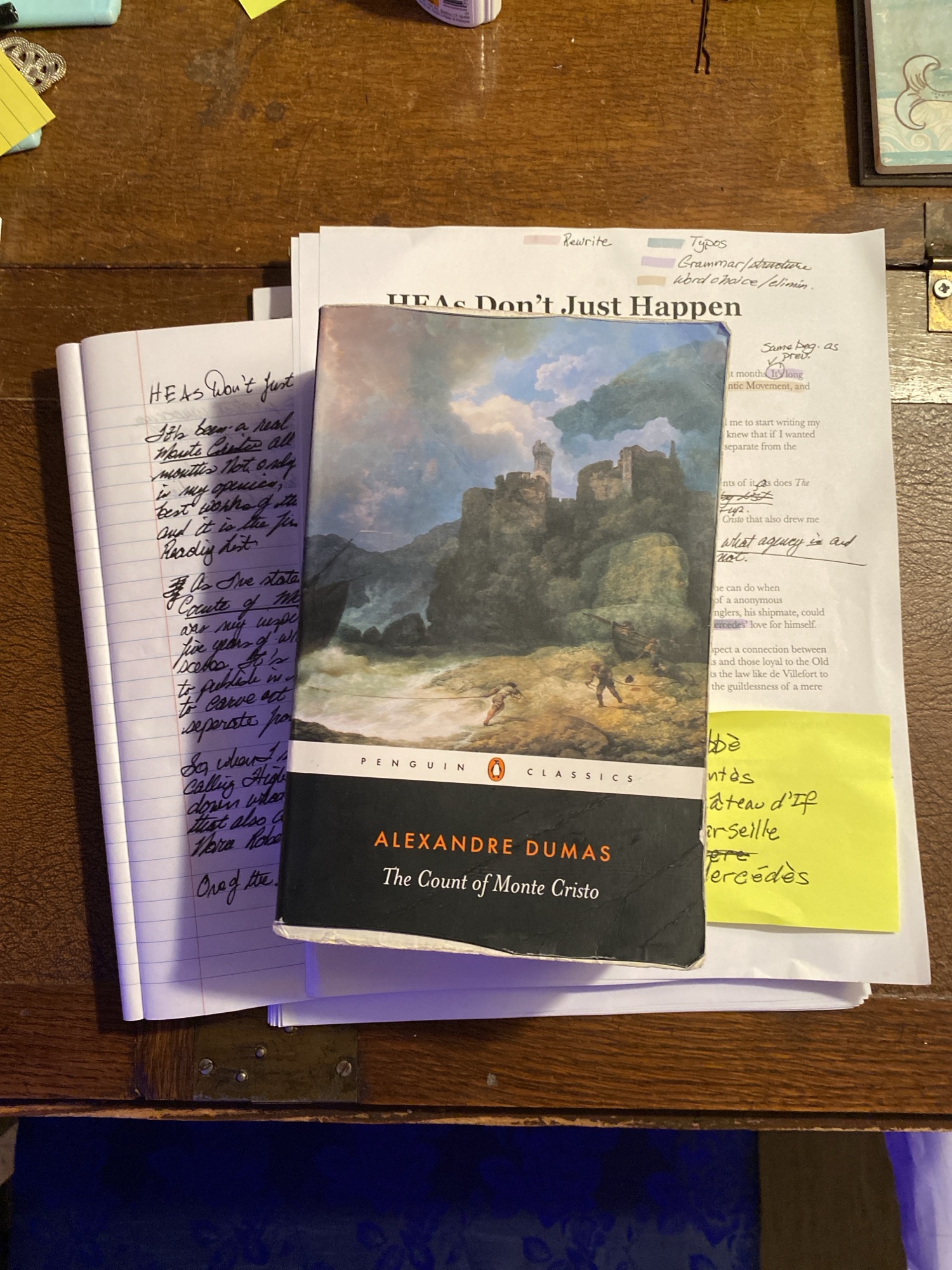
Agency in The Count of Monte Cristo
It’s been a real pleasure to see The Count of Monte Cristo all over social media in recent months. Not only is it Dumas at his finest, in my opinion, Monte Cristo is one of the best works of the wider Romantic Movement and it is the first book on my High Romance Reading List.
As I’ve already blogged on here before, it was The Count of Monte Cristo that inspired me to start writing my own novels, after five years of writing snippets and character scenes. It’s also why I knew that if I wanted to publish in the romance space, I needed to carve out a niche for myself that was separate from the current dark romance trend that’s taken over what used to be romantic suspense.
I have nothing against Dark Romance. Arguably, When the Moon Hatched has elements of it. As does The Count of Monte Cristo. But Dark Romance flirts almost too dangerously with realism in too many places, and it often sacrifices sentimentality and wonder for gritty emotional realism instead of poetic melancholy.
So, when I sat down and I actually thought very hard about what I liked in Monte Cristo that also drew me to other authors in romance, one of the themes I came up with was agency, or the capability to act.
Agency vs Empowerment
When I speak of agency, I am speaking very specifically of the capability to act instead of react. This is not the same as empowerment. Very often you have agency even when you do not have power. You may not have very many choices, but there is a lot that has to happen before you are unable to do anything.
Dumas himself plays with this in The Count of Monte Cristo on multiple levels, the primary one that sticks out to me is how the character of Edmond Dantès transitions from having low agency, to lower agency, and then ends as a high agency character. Even when there is no more recourse for him in the Château d’If, he does have one choice remaining to him—starvation.
He is powerless for the first third of the novel—he is powerless against the three men who act against him. He is powerless to receive justice for himself. But, while he is powerless, he does not lack agency. He finds ways of acting within his powerless state.
What I find almost too often in books discussions across social media is that empowerment and agency are often confused with one another. Many people assume lack of power means lack of agency. This assumption then becomes doctrine and not situational to the individual.
The truth is there are situations where powerlessness does equal lack of agency, especially when that lack is indoctrinated from a young age. Tia Leavings’ A Well-Trained Wife goes into this in more detail. Learned helplessness is something that only a few like to talk about, and even then they often get it wrong because they assume that it’s an attitude adjustment.
It’s not. Learned helplessness often results from systems and schools of thought that protect innocent to the point of naiveté. Undoing that requires more than a change of attitude, it requires a change of education.
Innocence Can Hinder Agency
Dantès was a simple, uneducated man; to him, the past was covered by a murky veil that can be raised only by knowledge. In the solitude of his dungeon and the desert of his thoughts, he could not reconstruct ages past, revive extinct races or rebuilt those antique cities that imagination augments and poeticizes to that they pass before one’s eyes, gigantic and lit by fiery skies […]1
Dantès’ own naiveté is a hindrance to his agency. He can’t understand why anyone would want to get rid of him, so he can’t see the real danger he’s in. His innocence is his very undoing.
A twenty-year-old Marseilles sailor with no formal education is limited in what he can do when confronted with a problem out of his depth. Even more so when he his imagination is limited to his own experience
By the time you reach the above quote in the novel, he has been arrested on the word of an anonymous accusation which he doesn’t understand, has sought a review of his case multiple times only to be abandoned, and has finally given himself over to despair. At this point, without any human company, or outside stimulation, he has nothing to fall back on to stimulate his mind.
Even after he meets Abbé Faria, it never occurs to him that Danglers, his shipmate, could possibly be responsible or that Mondego is willing to do what it takes to gain Mercédès’ love for himself.
Edmond sees nothing but good intentions in either man. Just as he doesn’t suspect a connection between Nortier and Villefort because knowing the names of prominent Bonapartists and those loyal to the Old Regime wasn’t part of his education. Nor does he expect a man who represents the law like Villefort to be more concerned with his own position in Marseilles society than he is with the guiltlessness of a mere sailor carrying out his captain’s last request.
It’s the abbé who points out the connections, and demonstrates how to evaluate the facts, and draw conclusions from the evidence because the abbé does suspect Danglars and Mondego, he does know the name of Bonapartists and the hidden history of Villefort. He’s probably one of the first and only people to demonstrate to Dantès the benefits of logic and the connection between motive and action.
Our knee-jerk reaction is to protect innocent at all costs—even at the cost of personal responsibility and development. We almost consider it a universal moral good. But that protection often is even more damaging when it discourages natural curiosity and the ability to reason and troubleshoot. At some point, innocence becomes a hindrance to survival and not an asset to anything other than a perceived social or religious ideal.
Agency for Good or Ill
Dumas’s master stroke is in how the various characters use, gain, or lose their agency. Dantès’ turning point is meeting Abbé Faria and finding out that he is not has helpless as he thinks.
He gains agency through improvement, through correcting the faults in himself and learning how to use his mind, how to acquire knowledge, and how to reason with the facts presented. By the time, he has completed his plans, he’s actually done France a great service. He’s identified and helped remove a corrupt official, he’s ended financial corruption within one of the most prominent private bankers, he brought a war criminal to justice, took two petty thieves out of operation, and uncovered a serial poisoner. Not bad for a sailor boy from Marseilles.
His enemies take a different route. They are empowered where Dantès is imprisoned and their agency is greater than his for the first fifteen or so years of the novel. Instead of using their freedom to actually build meaningful and worthwhile lives for themselves, we find throughout the novel, that the sins they committed to betray Edmond Dantès are the sins they still practice.
Mondego wanted wealth and position for himself. He slew Ali Pasha and sold his wife and daughter into slavery, removing the bar to his instant fortune.
Danglars wanted money and position. He helped remove Dantès from position as captain because he wanted that position. Then, he helped invest Mondego’s ill-gotten gains and maneuvered his family so that he got more of it, even allowing his wife to have an extramarital affair so that she got insider information.
Villefort craved power and position immune from political change. He was from a Bonapartist family, so he changes his name to his mother’s aristocratic name and hides his connection to Bonaparte’s regime. He has to appear morally blameless so he covers up an affair and the child it produced.
For them, action is there for their own gain and advancement. It’s not there for them to actually do good work in the world or make it better place or even to work on learning more about the world and their place in it. So, in the end, they are the same as they always were, just with more money, more wealth, and more sins following them around.
Dumas knew something of Dante Alighieri’s Divine Comedy and not just because his main character’s last name is Dantès. There are many parallels between The Divine Comedy and The Count of Monte Cristo and they are too deliberate to be coincidence.. One of the things any reader of Inferno has to come to terms with is that the people there chose to be there—not because they wanted to go to hell, but because they never changed. The frauds are there because they always chose to lied. The murders are there because they always resorted to murder.
It’s a thought Dumas weaves throughout Monte Cristo: what will someone choose when they have greater agency? When they are no longer desperate, will they choose better? Or choose differently?
Mondego, Villefort, and Danglars are the ones with most of the agency in the novel, and they continually use it to do exactly what they did in the beginning. And it’s by those same means that they meet their end.
HEAs don’t just happen.
‘Take care, Madame,’ said Monte Cristo. ‘That is not how God should be worshipped. He wants us to understand and debate His power: that is why He gave us free will.’
‘Wretch!’ Mercédès cried. ‘Don’t speak like that to me. If I believed that God had given me free will, what would remain to save me from despair!’2
Happy endings are not a reaction to events in romances, whether those are fairy tales or Romantic novels. Characters have to take action to reach their goal.
Dumas plays with this again through the central love story between Edmond Dantès and Mercédès Herrera. But, unlike a modern romance where the love interests get a second chance, Dumas chooses a different path that is determined by their respective agencies.
Mercédès, like Edmond, is innocent. Mondego is annoying, yes, and he doesn’t listen to her when she refuses his advances, but she’s quick to correct her fiancé when he identifies Mondego as an enemy. There’s her first failure in agency. He is her cousin and they are in an insular culture where they are only supposed to marry within the culture—something which Mondego calls a law and she a custom. That should have been her first tip-off—any time a man thinks something is his right, and that right is wrapped up in his pride, there are going to be problems.
Now, what’s interesting is that Dantès and Mercédès have nearly equal agency in the beginning, both are innocent, both poor, both without much family. This is an advantage to them initially becuase their marriage contract needs no negotiation. They are bound only by their love and desire to be married—the romantic ideal.
By the end of the book, it’s a different story. Mercédès is poor once again. Edmond has completed his decades-long mission. But, unlike before, Mercédès has no will to do anything about it.
She’s a woman who ran a successful household for nearly two decades—even Dantès points out that she had a right to at least half the Morcerf/Mondego fortune, whatever it’s origins because of her stewardship. And he would be right—running a household with servants, guests, and complicated rules of hospitality was a business enterprise requiring acumen and diplomacy. Women like Mercédès may not have had much political power, but that was sometimes offset by the amount of domestic and social power they wielded. A wife who networked within her husband’s social circle could raise or lower his prospects. Her ability to entertain and keep a beautiful house was a reflection on him—not just on her abilities.
But these are not realities she considers, even if Dantès does. He’s now in the position of Abbé Faria, pointing out what should be obvious to anyone with sense or logic. But unlike the Abbé who ended up with a willing student, Dantès’ logic with Mercédès falls on deaf ears. She even asks him why he would strip her of her only comfort by talking to her of free will.
Personally, I think that if she had taken her due, if she had not abdicated her will, then the ending would have been very different. In fact, I think she and Dantès would have eventually found their way back to one another, if not as lovers, then at least as extremely close friends.
But she doesn’t choose him, she doesn’t choose the comfort he offers, or even try to see if he could still possibly love her. She chooses her grief, and most importantly, she refuses to make any more decisions. She’s now a prisoner in her own mind.
While that sounds unbearably tragic—this isn’t the HEA we want in a romance—Dumas is showing that HEA’s don’t just happen because it’s fate. They happen because characters take action and when those characters do not, then they do not get their HEA.
Happiness does not happen by chance, it happens by choice.
This is High Romance—HEAs earned through agency and moral choice, not delivered by fate or left to chance.
If you want more of this—weekly essays on the romantic tradition, craft analysis, and reading recommendations that treat romance as serious literature—subscribe to The Eftsoons Letter. You’ll get my High Romance Reading List delivered instantly: 22 books from medieval epics to contemporary romantasy, annotated with why each one matters.
- Alexandre Dumas, The Count of Monte Cristo, trans. Robin Buss (Penguin Classics, 1996), 153. ↩︎
- Ibid, 1194. ↩︎

Leave a Reply