
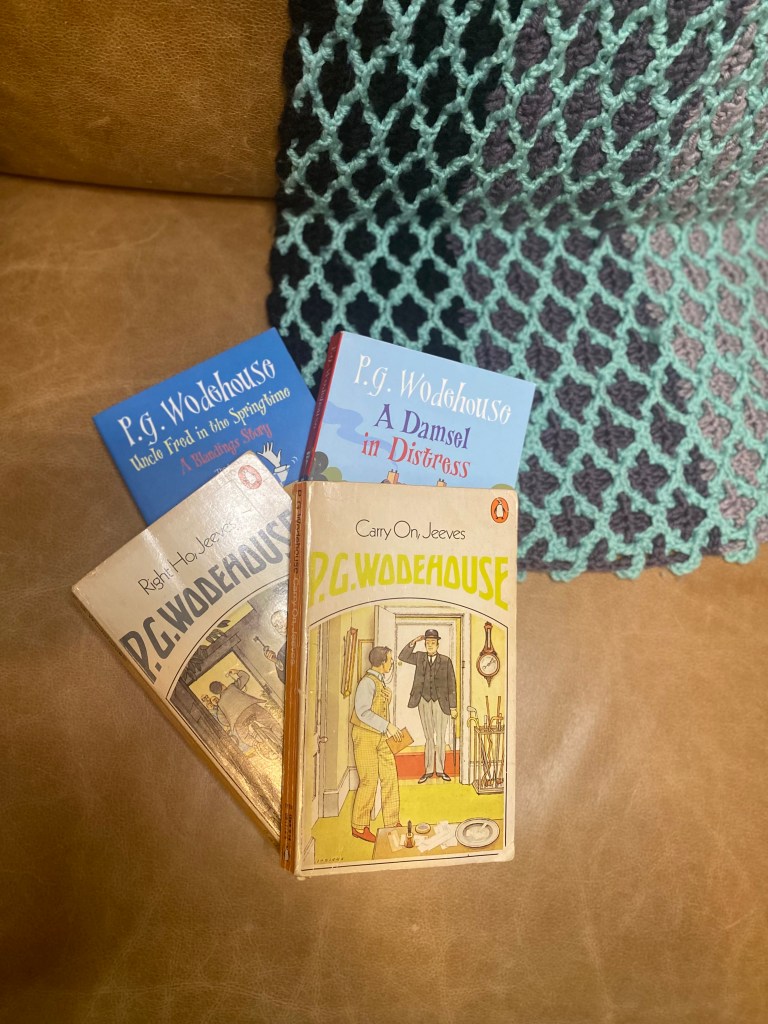
P. G. Wodehouse is another writer slapped with trigger warnings and sensitivity revisions. At first glance, most people today would probably jump to the assumption Wodehouse is outdated. Who has a “gentleman’s personal gentleman” these days, anyway? There’s no room for personal servants in this supposedly egalitarian and “free” society, is there?
This is before we even get to our current obsession with misgendering everyone, the “outdated” language, and many other problems we can create to criticize.
As with Ian Fleming’s novels, however, concentrating on what others may or may not think is offensive, distracts us from the things that are just a true today as they were in the first half of the 20th century when Wodehouse wrote.
Social drama hasn’t changed in nearly 100 years.
Bertie Wooster, the main character and narrator of all the Jeeves stories, largely gets into social trouble. This can range from crossing his Aunt Agatha, who thinks he’s “vapid and shiftless” to committing the almost unforgivable crime of inadvertently chasing off his Aunt Dahlia’s French chef Anatole.
The person who usually helps him out of these problems is his loyal and stoic valet, Reginald Jeeves. They’re smallish dramas, the like of which are probably like finding a favorite influencer uses filters on their media, or the average episode of “The Real Housewives of Fill-in-the-Blank.”
Now, to certain segments of the world, these are real, life-and-death problems. Being “inauthentic” is the same as being a hypocrite. We like to bandy about words like “align” and “authentic self.” We like to brag that we only shop brands, eat food, or enjoy pastimes that match our “values.” Deviations from “alignment” are mortal sins.
These are people who take the innocent pleasures of an ice cream sundae on a hot afternoon and turn it into a secret code for white supremacy. Much like Bertie’s Aunt Agatha sucks the joys from a well-laid luncheon table quicker than a Dementor sucks out someone’s soul in Harry Potter. Although I’d rather face his Aunt Agatha for all her dragon-lady personality than I would a modern-day Twitter mob. Aunt Agatha, at least, is a reasoning human being.
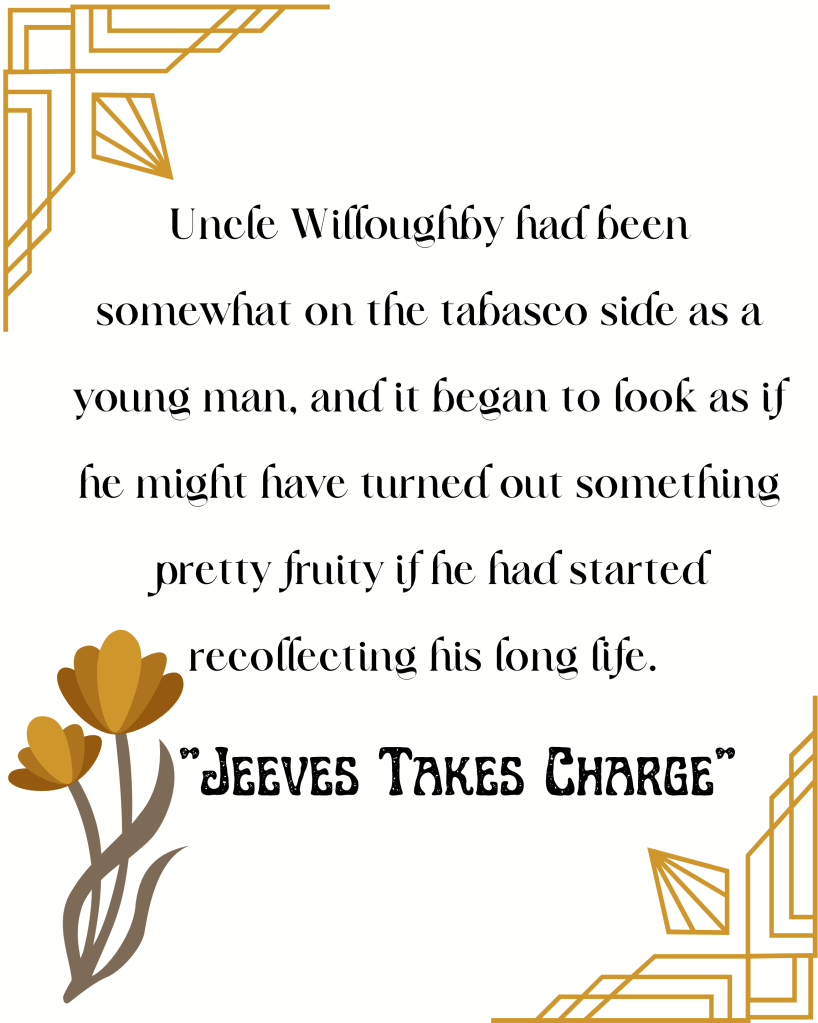
One of the first adventures Bertie goes on with Jeeves comes about because his Uncle Willoughby wrote and was about to publish stories about his life. The problem with this is that his Uncle Willoughby had led a very wild life in his youth.
Jeeves explains to Bertie at the end of the story that most people actually like to see their name in print, and that being slightly wild in youth isn’t necessarily a bad thing even if the stories are a bit ribald. It was, in fact, nothing to be that worried about.
Human nature doesn’t really change down the centuries. It just wears different clothes and speaks different languages. Would Uncle Willoughby be any different from anyone in a prominent position writing about some of the wild things they’ve done or experienced with friends in their lives?
Probably not.
Laughing in the face of disaster.
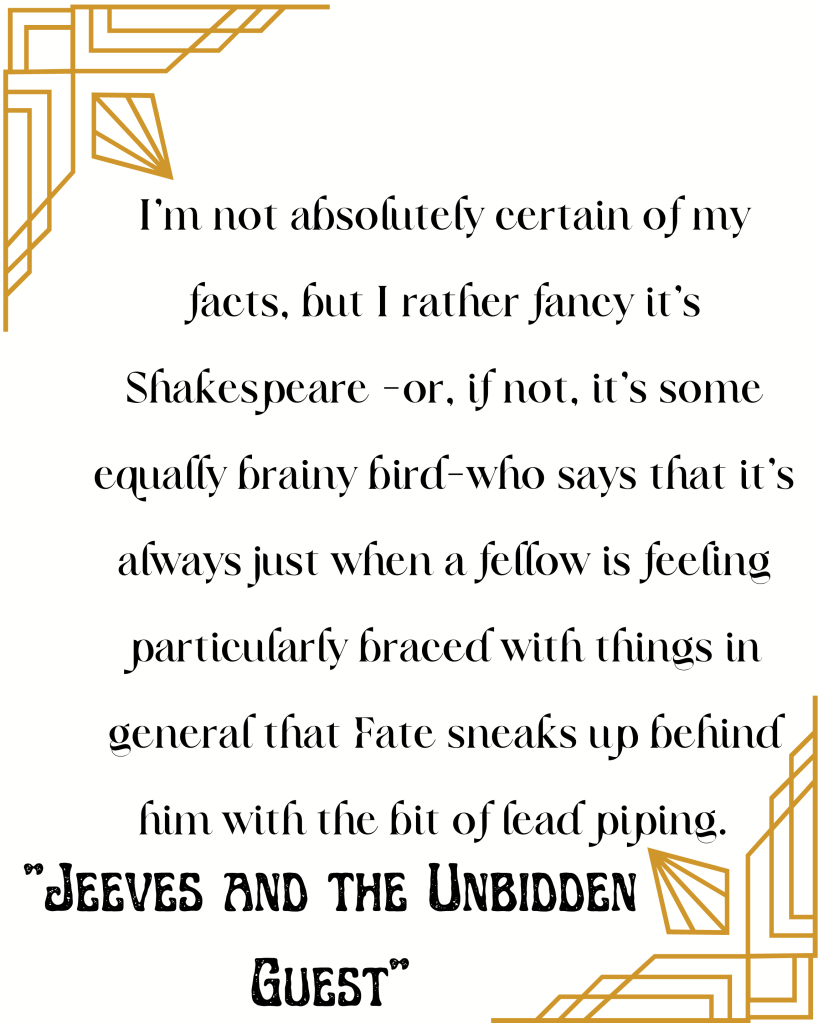
Many of Wodehouse’s novels involve impending minor disaster. Bertie’s Uncle Willoughby publishing scandalous memoirs in “Jeeves Takes Charge.” A spoiled child lays claim to Aunt Agatha’s dog in “Episode of the Dog Macintosh.” The list goes on.
Now, there are one of two roads you can take. You can take the “Keeping up with the Kardashians” route and turn it into a petty drama that makes the people involved look vapid and spoiled. Or, you can turn it into comedy so that everyone can laugh at the foibles of human nature.
Which would you choose? Well, if you merely glance at social media, it seems like most of the world has chosen the first option. But, P. G. Wodehouse didn’t. And that is despite him having some real-world problems.
P. G. Wodehouse was living in France in 1940 and couldn’t escape German occupation. He went through several internment camps for about a year until he was taken to Berlin in 1941 to do a serious of radio broadcasts to the USA, which was at that time neutral.
His broadcasts were humorous takes on life in the internment camps, but many in England excoriated them because, to them, he looked like a Nazi collaborator. There’s still much debate on Wodehouse’s role in Berlin during World War II and there are arguments for both sides. Personally, I take the view that Wodehouse wasn’t ill-intentioned. Besides, what was he supposed to do, tell the people who were his jailers no?
What would any of us do in a similar situation? Realistically, few of us are the rebels we think we are when it comes down to it. When the cold, the hunger, and pain kick in, most people look for a way out.
Again, that’s human nature. Just like taking petty social drama too seriously. We can pretend we’re better than that all we want, but no one actually knows what he or she will do in a similar situation.
Best leave the judgement up to God, don’t you agree? We have enough problems down here.
We need to learn to laugh again.
It’s easy to despair and criticize. It’s harder to create beauty and joy. Why that must be is anyone’s guess, but I expect it’s because when we are joyful and happy, it’s because the people who are truly miserable just feel more miserable.
I have known people who aren’t happy unless they are victims or find problems that somehow only they can fix. They only are happy when they are making everyone else miserable. Sometimes unintentionally.
The state of the world is such that we can no longer take a joke. Everything is an insult, even if it’s not meant to be. We’re not allowed to joke, to not take the world seriously, to laugh at some of the absurdity of life anymore.
We’re not even allowed to keep our own history and literature in its original form without “apologizing” for it.
Wodehouse is needful now more than ever before. In fact, I would say in our current climate, he’s easily as important as Shakespeare or Austen. I don’t say that lightly, either. But different ages need different things. And this age needs good clean Bertie Wooster silliness and a patient, Stoic Jeeves, to show us that everything really will all work out.
Discover more from K. B. Middleton, LLC
Subscribe to get the latest posts sent to your email.

 K. B. Middleton, LLC
“These are people who take the innocent pleasures of an ice cream sundae on a hot afternoon and turn it into a secret code for white supremacy.” Hahaha. Perfect social commentary, Kathleen!
LikeLiked by 1 person
Thanks! I’m rather pleased with that turn of phrase myself. It’s not often I come up with a good zinger like that!
LikeLiked by 1 person
Hahaha. Keep it up!
LikeLiked by 1 person