
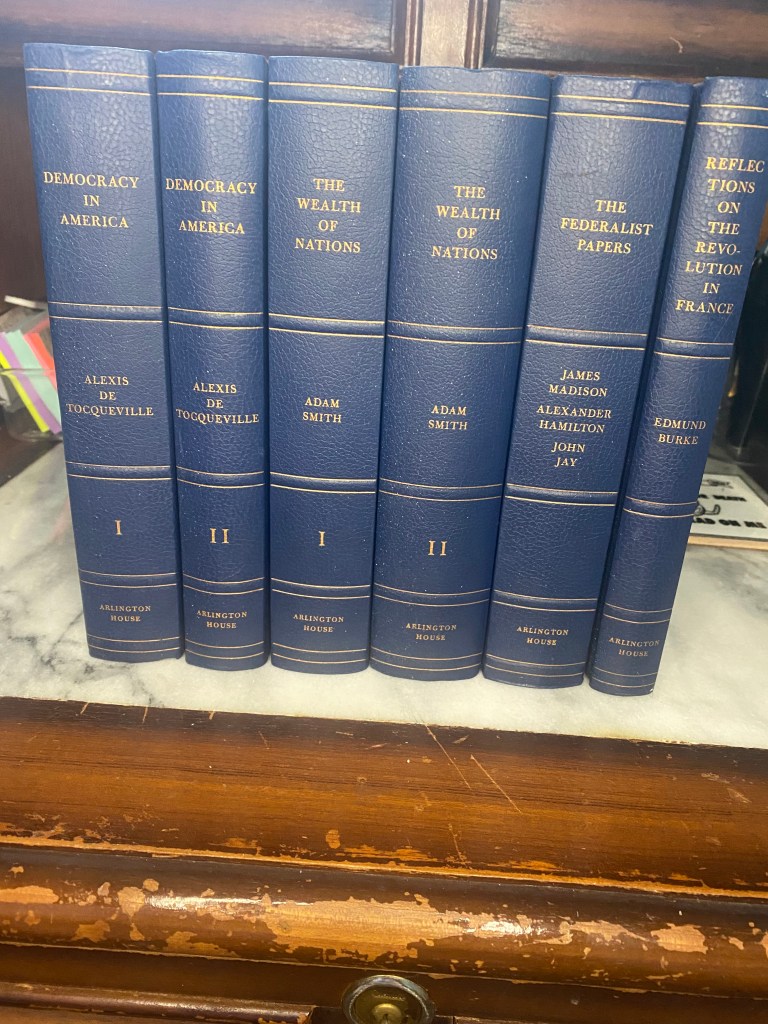
First things first: this is not a comprehensive list. Freedom, as a concept, comes in many forms and means different things at different times to different cultures.
For the Native Americans, freedom meant the freedom to continue as they always had, free from interference. For enslaved Americans pre-Civil War, it meant the right to live for themselves and not for someone else. For the modern-day American, it means the ability to work and live which allows them the freedom to take care of themselves and their families without having to justify it to a non-elected official. Or a boss who doesn’t have any business knowing such things.
The books on this list talk about civil freedom’s story in the United States. This is the freedom to vote, to be socially mobile, and to engage in civil discourse as equals before the law.
It doesn’t mean everyone will get equal results. This was to bring the landed aristocrat on par with the farmhand. Not to guarantee the farmhand will become the aristocrat.
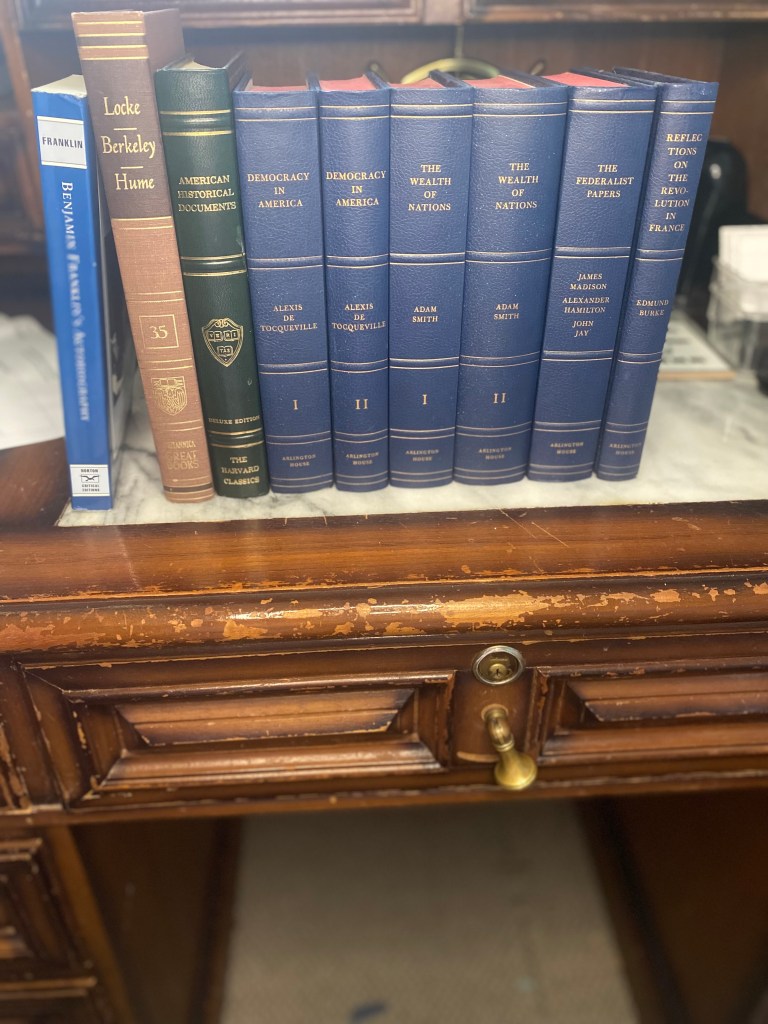
American Historical Documents
You’ll find a lot of vintage books that have this very general title. I have two. The one I have pictured in this post includes:
- First Charter of Virginia (1606)
- The Mayflower Compact (1620)
- The Fundamental Orders of Connecticut (1639)
- The Massachusetts Body of Liberties (1641)
- The Declaration of Independence (1776)
- Articles of Confederation (1777)
- Constitution of the United States (1787)
- Treaty with the Six Nations (1794)
- Emancipation Proclamation (1863)
- Gettysburg Address (1863)
There’s more than this in my volume, too. And it still isn’t the entire story.
The Federalist Papers (1787)
Every “state” in the new nation that emerged after the American Revolution had to “ratify”–accept–the Constitution. This is another saga of the story which you’d do well to research because it was touch and go there for a while.
To convince people, the Constitution was the best way forwards, Alexander Hamilton, James Madison, and John Jay co-wrote a series of articles which we now know as “The Federalist Papers.”
These are still significant because they explain how, and why, the Constitution would work. Ever wonder what your favorite writer intended? Well, “The Federalist Papers” are about as good as it gets. Considering James Madison was one of the people who wrote the Constitution, this is about as good as it gets when it comes to judging authorial intent.
Democracy in America (1836)
If you don’t trust the people who actually fought in the American Revolution or write the U. S. Constitution to tell you the truth, get an outsider’s viewpoint.
Alexis de Tocqueville traveled in American from 1831-1832. He was born in 1805–after the Reign of Terror but during some of the most turbulent times in modern France’s history. He lived through Napoleon, and through three more revolutions in the political life of France. He was no stranger to societal upheaval or to the machinations of state.
He also paints a picture of American democracy as a mark of humanity’s progress. Today, we know “progress” in the 1830s was a very relative term, at least in comparison to our own ideas of civil rights.
So, why read this book? Well, Tocqueville had seen authoritarian despotism in his time. Europe wasn’t yet part of the “free world” as we like to term it these days. His work not only highlights the blessings of liberty, but impresses the importance of defending them from apathy, despotism, and from those who would rule absolutely. He’d seen it happen in France and he didn’t want it to spread.
John Locke’s Works
John Locke is an important writer and thinker of the eighteenth century because he helped develop many of the ideas we now have about the separation of church and state, the rights of the common man, and the need for the various sects of Christianity to get along.
Substitute Christianity with “religion” and you have, in a nutshell, part of what today’s struggles are still about.
Locke may be overly optimistic in hindsight, but his ideas helped inspire other Americans like Thomas Jefferson (as flawed as he was), James Madison, Benjamin Franklin, George Washington, and the list goes on. Tolerance back then, meant something very different to today, but it’s not lost any relevancy in the interim.
Christians still fight amongst themselves, and along many of the same lines as before. Just read the comments on any Catholic post and you’ll find rabid Protestants still calling them pagans and accusing them of all sorts of horrible things.
As if the Protestant Church is any better, as “Shiny Happy People” on Amazon has so recently proven.
Pick up John Locke and give him a read. You’ll find him very succinct and a delight to read.
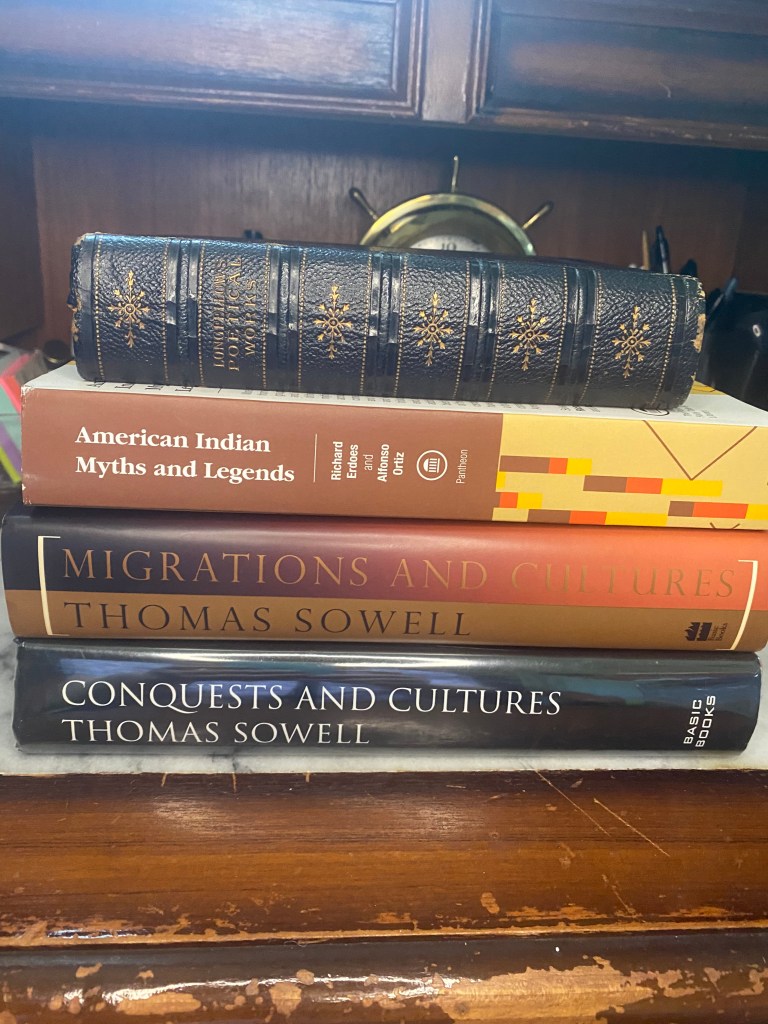
Thomas Sowell’s series on cultures.
Thomas Sowell wrote several books on cultures. The two I have pictured are “Conquests and Cultures” and “Migrations and Cultures.” These are insightful, broadly generalized viewpoints of world history that address the topics of conquests and migration, respectively.
But the way Sowell delves into these things is far more balanced. He doesn’t lump everything into a class struggle, or a racial struggle. It looks at the cultural struggles involved. Yes, race enters into it. But not just “white” and “black,” but the subdivisions within those races.
For instance, when he goes into the struggles in Ireland, he is quick to point out that Northern Ireland specifically is a sore point not just because of the old Catholic vs Protestant debate or the English vs Irish debate. But because the English transplanted Highland Scots to Northern Ireland.
And ethnically, Highland Scots and Irish are two distinctly different peoples. Cousins, yes, as we now know. But culturally different people, whatever their similarities. Add to that, Belfast (Northern Ireland) was a major port for moving people from Europe to the English colonies in North America.
Johannes Poston, my 6th great-grandfather, was originally from Shrewsbury on the borders of England and Wales. He went through Belfast on his way to North America. And he went over indentured. Little better than chattels slavery.
Understanding the world as a clash of cultures, each with its own history, tempers much of the ideological extremism you find elsewhere. Racial tensions aren’t just about looks, but they are about cultures. And each race has its own mix of cultures that have their own baggage.
Benjamin Franklin’s Autobiography
While dry in places, there’s nothing like reading one of the most influential figures in pre and post Revolutionary War America in his own words. Coincidentally, there is a fictional version called “Ben and Me” where Franklin’s life is told from the viewpoint of a mouse. Walt Disney even made it into a cartoon at one point!
Why read? Benjamin Franklin was present both at the Declaration of Independence and the United States Constitution. Not reading him would be like
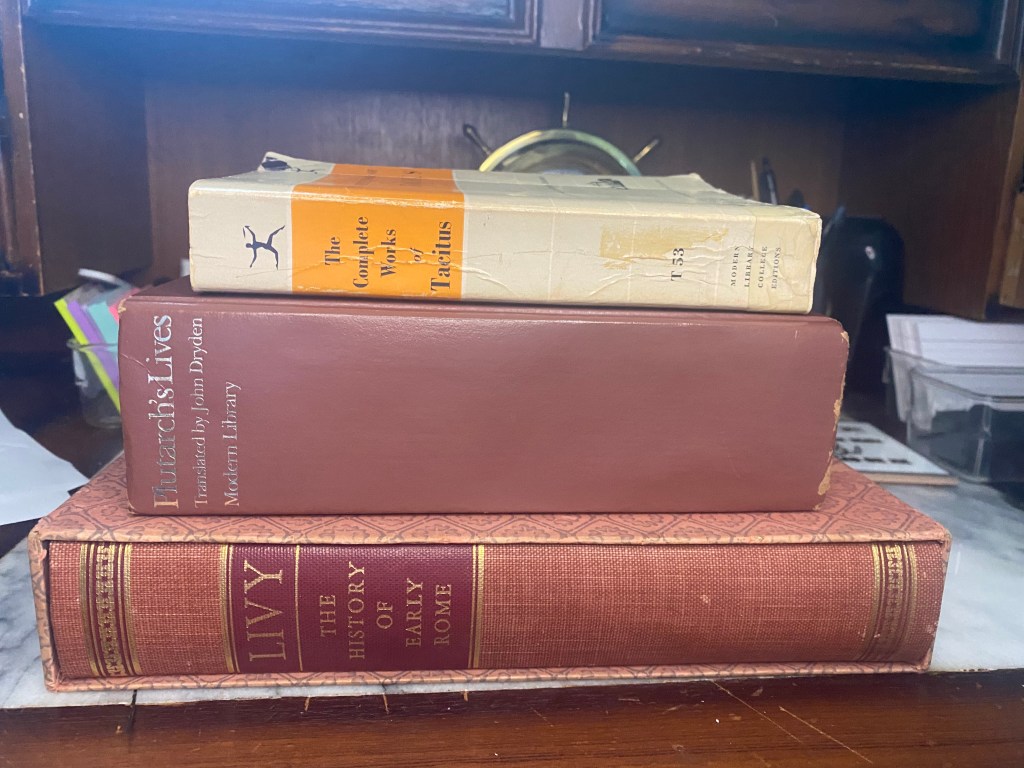
Roman Historians
Why have Roman historians on this list? Because Rome, and consequently Greece before it, have the most influence on Western history.
They also tell us the most about how civilizations collapse. Because collapse it did, and we’re still living with the fallout.
No education is complete without these!
Additional Writers:
These are writers that are also worth reading. They are well-documented elsewhere, so I’ve not gone into detail here, nor have I put them into any particular order.
- James Fenimore Cooper (The Leatherstocking Tales)
- Henry Wadsworth Longfellow (Song of Hiawatha, Paul Revere’s Ride)
- Frederick Douglass
- Sojourner Truth
- Langston Hughes
- Aristotle
- Plato
- Epicetus
- The Magna Carta
- St. Anselm “On the Freedom of Choice”
- Dante Alighieri “De Monarchia”
- Mary Wollstonecraft: “Vindication of the Rights of Woman”
The “why” matters now more than ever before.
Over my lifetime, I have seen the United States’ legacy being twisted, beaten, and abused for the ends of people who have their own motivations. And I mean that unilaterally.
Fundamentalism twisted American liberty into a cult-like status that equated patriotism with religion. Dissenters were not welcome. In fact, they were against the “chosen” people–American Christians (as long as they weren’t catholic) and wanted to usher in the do-called “Dark Ages.”
Left-wing extremists, now called “woke” are doing the same at the opposite extreme. Entire groups of people are being erased through language. Dissenters are the next generation of Nazis and they too want to undo any and all “civil rights” to return everyone to the “Dark Ages.”
In both cases, a tiny group of people was twisting American liberty into a cult where it’s their liberty that matters and all others have to bow before them. Lest ye be cast into outer darkness. Or called a Nazi.
Both sides failed to educate on the broader story that our civilizations present. One in favor of a limited, bastardized Christianity that cut out The other is in favor of totalitarianism based on identity.
Neither is how good government, civilization, or how free human beings are meant to function in this world.
To keep freedom, we have to learn how to use it, and learn why we must keep it at all costs. And to do that, we have to keep reading the classics.
Happy 4th of July to everyone in the United States.
And to England, our Motherland, thank you. Our success is largely because we learned at your knee. Had it not been England, our fates may have been so much worse.
Discover more from K. B. Middleton, LLC
Subscribe to get the latest posts sent to your email.

 K. B. Middleton, LLC
👍🏼
LikeLike