
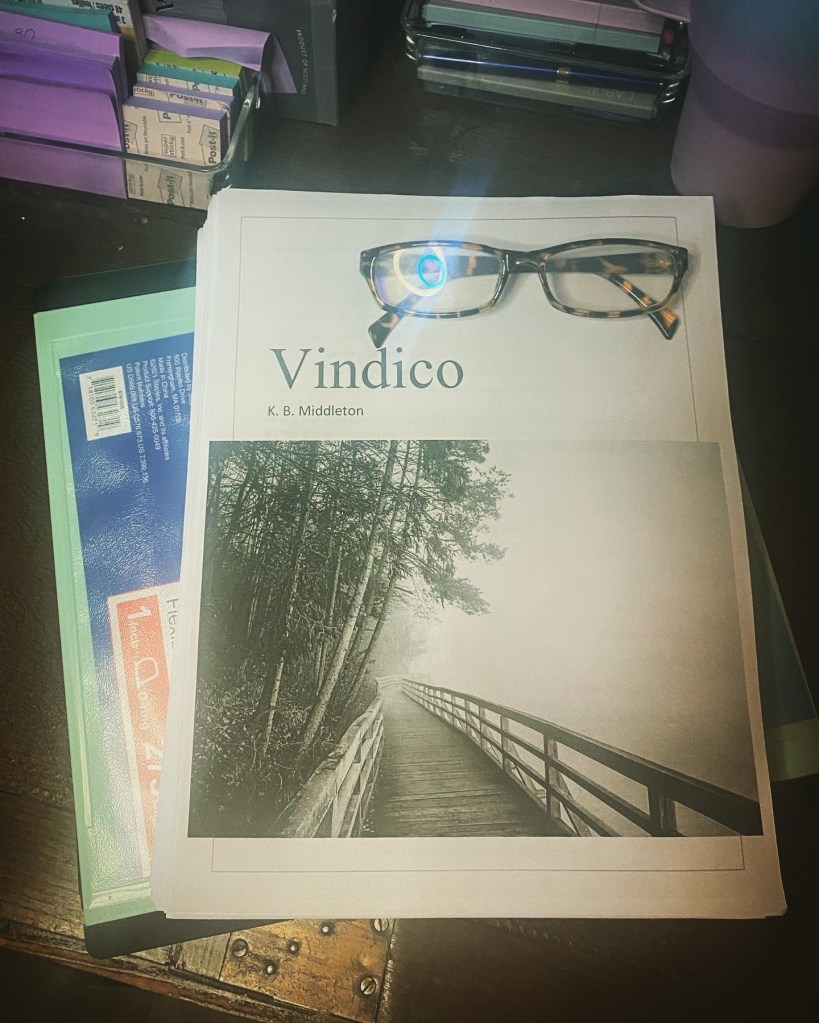
Progress on Vindico has been slow. Three years and counting. This doesn’t even include the pre-writing I did before. It’s nowhere near Gustave Flaubert’s seven years to write Madam Bovary. But it’s also not as fast as Alexandre Dumas, who wrote the bulk of his greatest works, including The Three Musketeers, Twenty Years After, and The Count of Monte Cristo in the space of ten years.
Don’t even get me into Nora Robert’s fantastically high output or Stephen King’s.
You’ll see a lot of how-to articles out there on novel writing, from how to plan your plot and then plot your plan, to going by the seat of your pants. I take most, if not all, of this with a grain of salt.
The best way to write a novel is to write is one word at a time.
You are not always the one in control.
So, you think you’re in control of your own novel, do you? Well, if there’s one thing I’ve learned from the last three years, it’s that you have, in reality, very little control either over your process or your characters. Some processes work well for some aspects of writing, but not for others. And, sometimes your characters will get up and start doing things you don’t expect.
Yes, you can always delete those unexpected turns your characters take you down. You can force them to do what you think you want them to. YOu can, but if you’re like me, you won’t have the heart to. My characters are their own people. They are part of me in that I had a hand in their creation, yes, but they aren’t mine to do with as I please.
If I tried, for instance, to make Jason, my main male character (MMC) a, for lack of a better term, wimp. He’d violently rebel in an instant. If I made him more reckless, he’d immediately show me why, in fact, couldn’t be more reckless, even if he tried. He’d even show me what I think is recklessness is him springing to action after a lot of thought.
He thinks in plots and suppositions, so when he’s preempting something, it’s really because he’s already seen it as a viable possibility, not because he’s reckless. Of course, he always shows me that right after I introduce a frisson of doubt into the text.
What’s a writer to do? I’m taking the approach of allowing whatever my characters want in the moment to be. I can always trim or refine when I start truly editing the novel, but until then, I’m going to let them do whatever they wish to do. It’s working out even better than I hoped and things I’d thought would not fit into Vindico are making sense and fit.
It’s equal amounts terrifying, exciting, and frustrating.
You can’t confine your ideas to a computer.
Some writers still use a typewriter, or at least a typewriter-style keyboard for their writing. When Jessica Fletcher switched to a word processor from a typewriter in Murder, She Wrote, it echoed a larger change in the writing world. The age of Christie, of DuMarier, Fleming, and Hemmingway was truly on its way out.
Or so you’d think.
I wrote the very first words that would become Vindico on a computer. In fact, I wrote them on a Lenovo laptop that I still have. I also wrote the first attempt at a rough draft for Vindico in Microsoft Word on my current (and perfectly wonderful) MacBook Pro.
But, I didn’t really piece everything together until I’d embraced writing the rough draft by hand. Yes, in old-fashioned-joined-up-handwriting. I’d written much of the back material this way, too. I bought a bunch of composition books from Staples when they were a mere 50¢ or so and I wrote in mechanical pencil all the stories of how Jason Cristo came into being.
I’d abandoned this for the rough draft because I thought it would be faster. Well, it’s physically faster to type than it is to write by hand, but I’ve found that for me, at least, it doesn’t produce better writing and it’s harder for me to reference what I’ve already written.
I’ve always had a hard time reading computer screens and processing the information in the same way. E-books are great for writing that doesn’t need a lot of thought, but if I actually want to digest and consider what’s being written, I need physical paper to do so.
If you’re struggling and only using a computer, then try going back to the old methods. Sometimes, the change helps get the words flowing again.
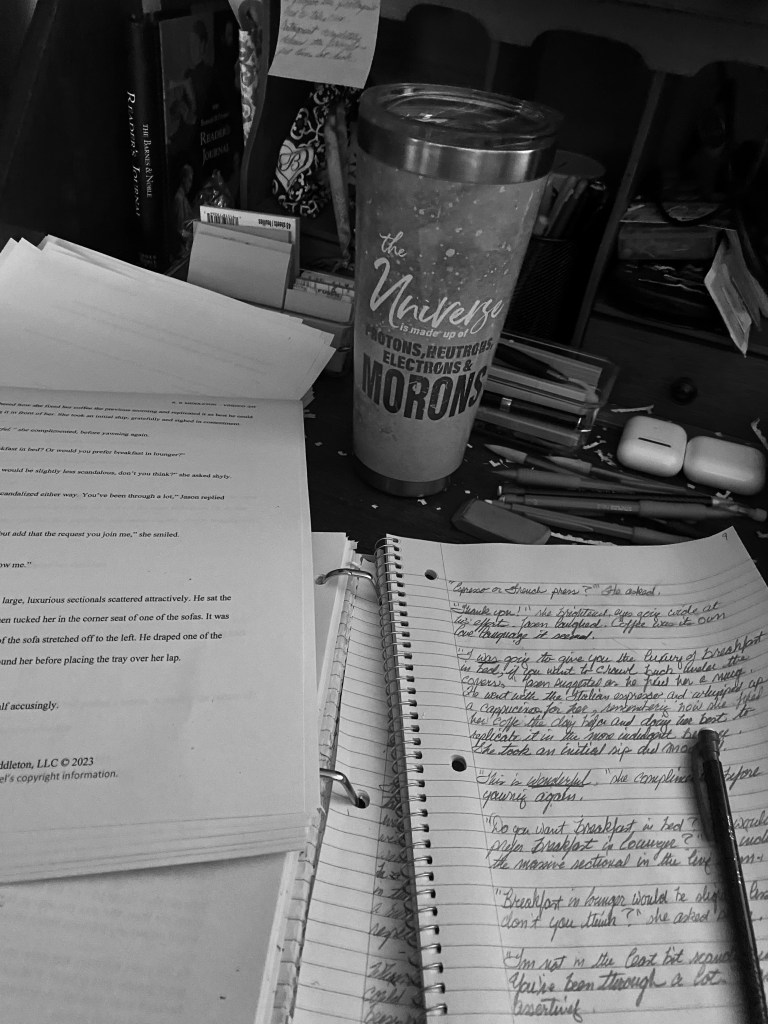
This is what my writing desk looks like…
Leaning into the writing’s physicality.
Also, there’s a lack of physicality when you relegate yourself to just typing everything out. Writing should be work. And typing, while is definitely is work, isn’t physical enough for me to really connect the ideas of writing and work.
In The Canterbury Tales, Chaucer describes the Oxford scholar as having near-permanent ink stains on his fingers from writing. Shakespeare’s death is sometimes attributed to cerebral hemorrhage brought on by the years of physical and mental labor required in Elizabethan theater. Writing is hard work. And it should be physical and mental.
Writing involves references source material, flipping back and forth between sources, writing plot points out on cards and charting them, and so much more. You don’t get that if you just sit at your desk all day and only type.
And boy, does my writing hand hurt if I’ve been at it all day! But it’s what one of my ballet teachers would have called “a good hurt.” A “good hurt” by the way was an indicator that you were using and developing more muscles.
So, why write by hand? Well, in my case, it allows me to fully form my thoughts. I have a horrible habit of my hands and brain not being in sync when I transmit thoughts to paper (or computer screen). Writing by hand forces me to slow down mentally so that I can physically keep up.
Are there times when I’ll still type? Certainly!
If there’s an emotion I need to get down (I call this “method writing”) because I know what I’m feeling in a moment is exactly what I want one of my characters to feel, I’ll type just to get the raw feelings out.
But, I’ll work those feelings into the page by hand. It’s what works for me and it staves off the infamous “writer’s block” just as well as anything else out there. Also, for me at least, since most of my favorite writers all used pen and paper themselves, there’s a sense of continuity there that I don’t get otherwise.
Writing word by word and day by day.
If you delve too deeply into “productivity” coaches or “thought leaders,” you’ll be tempted to think that unless you write a certain number of words a day, you can’t possibly become a writer of any repute. Uh-huh. Sure. Whatever makes you think you’re superior to us lowly mortals, I suppose.
Very few people can work at 100% capacity every day and the “growth mindset” enthusiasts don’t take into account very real setbacks like depressive episodes or chronic fatigue in their thinking. If you approach writing the same way and can make it work, more power to you. But if you cannot, then you’d be just as wrong to think you aren’t cut out for it.
Writing is writing whether you managed 500 words that day or 5,000. The trick is to write every day, even if it’s just a grocery list. Writing is a cumulative art. Not a science, not a machine process. If you think otherwise, then you aren’t really a writer, and I’d be willing to bet you’re one of the pessimists regarding AI.
Productivity is empty when it’s not tied to real life. When your sole purpose is to be “productive,” then you’ve already resigned yourself to being a robot. If that’s the case, then AI really will come for your job.
And, I know life, even if I know very little about publishing or about being a successful writer.
So what if you don’t hit a 3k word per day goal every day? Does this mean you’re a failure? Did you miss your goal because, say, you were out of underwear and needed to do laundry?
Well, that’s hardly a failure, is it? And for all of you out there saying “just pay someone to do it” that’s about as useful as telling a 20-something in a minimum wage job, the reason they don’t have a house is because of avocado toast. Or blaming long lines at Disney World on “childless millennials.” Hint: most of us can’t afford to pay someone to do the laundry if we also want to eat.
I don’t think J. K. Rowling had that kind of disposable income when she was on the dole writing the first Harry Potter book. Neither did Nora Roberts at the very beginning.
Productivity is subjective. Rest can be just as productive as staying busy for its own sake. In fact, I would argue that it’s more productive. Overthinking, for instance, isn’t productivity. It’s self-sabotage. So is doing a bunch of meaningless tasks without a specific end goal in mind.
Top tip: If the person giving you advice on a creative endeavor has done nothing approaching the same work, then chances are it’s not good advice.
Stay the course.
The only correct way to write is to not stop writing. Whether that means you have to write every other day to give yourself time to process, or if you have to break out your notebooks and write it all out by hand first. The only wrong way is to give up.
Word counts are a tool, productivity advice is a tool. And not all tools are good for all people for all jobs. You don’t just write a to-do list for your novel and then follow it to the letter.
Create, adjust, let your characters be themselves and, most of all, allow yourself to be the writer you are naturally.
I’m currently reading The Awakening by Nora Roberts. This is a slight departure from the novels she’s known for because it’s more fantasy than it is romance or romantic thriller. But it’s definitely her style. Now, if someone told her “you can’t write that way, it’s not in your niche” do you think she should take that advice?
Given that Nora herself has over 230 books to her name, I think she knows exactly what she’s doing at this point. And she’s writing what she wants to write, whether it’s in her “niche.” By the way, The Awakening is the first in a trilogy and the last one comes out on October 17. So, here’s to niche-smashing.
Stay the course, be the writer you want to be. Write the story you want to write. If it fits in to a “niche” great. But let nothing or anyone hamper your ability to produce quality writing. And quality writing is something you must discover for yourself.
Word by word and day by day.
Sign up for my newsletter for updates on Vindico, what I do as a Virtual Assistant, and more!
Discover more from K. B. Middleton, LLC
Subscribe to get the latest posts sent to your email.

 K. B. Middleton, LLC
Hilarious skit on novel writing “one word at a time” 🙂
LikeLiked by 1 person
🤣😂🤣😂🤣 I had no idea this even existed! Love a good Monty Python sketch. Now I’m goi g to have that running (or, perhaps, writing?) through my head now every time I sit at my desk. Thanks for sharing and reading!
LikeLiked by 1 person