
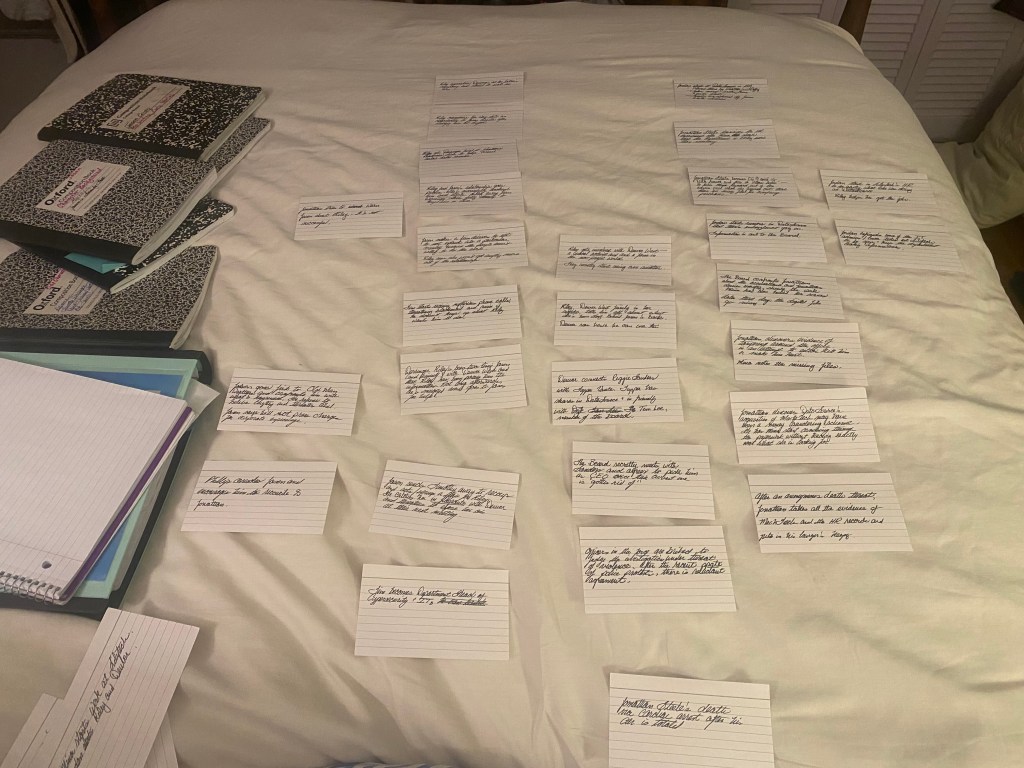
Creativity looks like this…
Most of my writing is within a business context––not a marketing or creative context. I’ve written technical proposals, emails, SOPs, and employee manuals alike. Most recently, I finished a year-long documentation project with 6 manuals to show for it. It was a dream job for any writer.
Technical writing, which includes writing manuals and processes, is often associated with people in industries like computer science, healthcare, or government contracting. This is a misnomer because every industry needs technical writing, even if there’s nothing “technical” about it.
So, it may surprise you to hear that working on that year-long documentation project was the key to breaking out of the stalemate I was in with my novel, Vindico. It sounds strange, but when you consider what goes into writing a manual, then writing a manual and writing a novel are more like two sides of the same coin rather than two different coins.

Confusion around the world “technical”
What do we mean by “technical” anything? I mentioned above that when we say the word “technical” we think technology more than we do anything else. This is no doubt because of the large amount of technology present in our everyday lives here in the brave new world of 2023.
But it’s not an accurate definition.
Heading back to my ever-trusty Oxford Dictionary of American English, “technical” refers to technique––not technology as we would assume. Now, if you look at the second definition of the word, that’s when you see the association with science and technology. So, it’s associated with technology, but it is still, foremost, about technique.
Technique refers to the “art” of doing something. Or how you do it. Well, the how of doing something applies to anything you care to imagine. Any of the arts and crafts have technique, for example. Literary criticism refers to the various techniques of evaluating a piece of literature. Any action you care to name has a technique.
So, when we refer to “technical” writing, we’re referring to writing that goes into almost detail of how to do something. Whether that’s how to run a program, how to manage the office, or how you are to behave in a workplace, technical writing deals with the how.
And technology doesn’t always figure into it.

Order over Audience
So, when you are writing about how to accomplish something in your client’s organization, what’s the most important thing to consider? I would argue the most important thing in writing a manual is the order of events.
For those of you who immediately think “the audience,” you are only partially correct. Your audience for a manual or a process isn’t segmented in the same way it is for a marketing piece. For instance, you aren’t writing for a customer avatar named Bob, who works at ABC, Inc, drives a 2009 Prius, and enjoys golf on the weekends.
This kind of thinking results from our marketing-heavy hustle culture. It’s fantastic for getting goods to the people who will buy them, but whether you’re writing a manual––or a novel––I’m going to argue for order of events over audience considerations every time.
When you’re writing a manual, you want to accomplish something very specific with the manual. You are instructing a swath of people who may be all over the demographic scale. Now, if you want to write a manual specific to Bob of ABC Inc, who drives a 2009 Prius and enjoys golf on the weekends, that’s great. But is Bob representative of all the people who need the manual?
No. Not every employee you hire or customer you gain is going to be Bob.
Just like every reader who picks up a romance novel may not like Jane Austen or the Bronte sisters, even though those ladies between them practically birthed the modern-day romance. Hard to imagine, but it’s true. Not every romance novel reader likes the romance genre. Not every Lee Child or Michael Crichton reader is a thriller fan. You can have someone love Agatha Christie but detest Sherlock Holmes.
So, if you’re stuck on getting the audience segmenting just right for your writing, take a break and set it aside. Focus on how you are organizing the information first.

How Ordering Information Helps Creativity
This is where a lot of us struggle regardless of what we write. Writing a novel, it’s hard to decide what is supposed to come next. Sometimes, you can make a good start and you feel the order just isn’t right but are at a loss at how to fix it. This is where I was earlier this year in my novel.
What did writing manuals do to help? They forced me to put information into an order that made sense for my client and their organization. It was making sense of the information that was already there, plus input from subject matter experts. It was creativity at its most basic function: creating order out of chaos.
The idea you want to put into reality is nebulous. It has no form and no physicality outside of its presence in your mind. It’s only when you put that idea into words or physical form that it becomes real for everyone else, too.
When I was writing the manuals for my client, there was some reality to the programs. They were being executed, but the results were not repeatable because the instructions to get the same results didn’t exist except inside the minds of the people running the program. To make what they did a reality for others, that meant the information in their heads had to be categorized and then communicated clearly for anyone who tried to read it.
This means that as long as you follow a logical order to the information, you’re golden. You don’t have to write only for Bob from ABC Inc, who drives a 2009 Prius and enjoys golf. Bob from ABC Inc, who drives a 2009 Prius and enjoys golf, is just an avatar––a made up person for you to use as a mannequin.
When you’re stuck writing your novel, if you approach writing without a specific demographic in mind, like when you’re writing a manual, it’s easier to categorize the information you need and it’s also easier to move forward sometimes. Not every creative mind works well within set boundaries. Some of us have to pretend the boundaries aren’t there.
So, if ditching the marketing avatar is what you need to do, make that your secondary concern. That’s why we edit.

Flow and Function
We like to talk a lot about making your writing flow naturally. Chapters should have neat endings, scenes should transition from one to the other seamlessly, etc. This is true in some technical writing as well. If you’re writing a proposal, for instance, you want to make your proposal as effortless to read as possible. Why wouldn’t you?
Accomplishing this, however, is where the art of writing comes into play––that pesky technique we talked about earlier.
When I wrote the manuals, I made sure that where it made sense, there were short “overviews” to new sections or subsections of the manual where the topics didn’t necessarily flow logically from one to the other. Overviews are not only a great transition piece, but they also allow you to address any underlying assumptions.
This is where function comes in.
I began the sections that explained the specifics of each program. The overview laid out the assumption that every program location was going to be slightly different depending on their specific circumstances. So, the overview provided the bridge from the previous section, but it was still functional. It wasn’t just a puff piece.
Thinking of form and function creatively
So, when I went to write my novel, the “puffy” pieces of writing that were meant to help transition were opportunities to tell another facet of the story. For instance, my main male character (MMC) has a fairly extensive backstory. So does my main female character (MFC). This means that those transitions are a place to deal with the other threads of their stories.
The only difference is that the transitional scenes in my novel are usually drafted independently of the surrounding sections and then inserted where they make the most sense and adjusted on an as-need basis.
This is one secret to what I like to call “writing in layers.” Truly great novelists like Victor Hugo and Alexandre Dumas are masters as this, nowhere more than in Dumas’ epic The Count of Monte Cristo. There is form and function. When Luigi Vampa is introduced, for instance, he’s introduced as Edmond Dantes is re-introduced as the Count of Monte Cristo. It’s Dumas’s way of transitioning from the backstory––the initial betrayal––to the main plot.
We return to Luigi Vampa at the end of the novel, when the main plot ends and the resolution––the Count’s clean-up during the aftermath. When we bid goodby to Luigi Vampa, we bid goodbye to the main plot. The Count has his justice. He can move on.

Format or Doormat
If you don’t format your writing, your writing is as good as a doormat because neglecting to put physical order into your writing makes it all too easy to wipe your feet on it as you move on to something else. Like a doormat. We don’t want our writing to be a doormat.
Neglecting formatting as you are writing is just as likely to land your writing in the doormat position as neglecting it as your editing. Many documents and documentation projects will have 2-3 people working on the same document at the same time. Having people reading what you’re writing as you write it may be disconcerting, but it highlights more strongly the need to format.
If your collaborators are the subject matter experts, then they need to see what information is there so they can determine what is missing. Formatting, in this sense, is a critical point of communication without which you may have a disaster on your hands. So, taking the extra time to clean up your formatting as you go can help anyone you’re working with on a document to work smarter, not harder.
Formatting to stay creative
At some point, most writing advice turns to the very desperate, although very true, adage that writing is an action, so it’s best just to get on with it. When you are perfecting your writing technique or style, this is exactly what you should do. Don’t worry about the format. Don’t worry about word count, page number, or anything else except the ideas you want to transmit.
This is partially why the 10-minute freewrite is so effective.
Well, if you have several writing projects going on, however, this isn’t the most helpful advice. You can’t always go full-tilt on your writing for hours on end. Many novelists and aspiring novelists have additional jobs to make ends meet. Treating your writing like a regular job it’s the correct mindset to have––it’s a mindset I’m getting more deeply into as well––but it’s not always a reality.
You need periods of rest and reflection too. If you’re at a point where you can’t write any more, or you’re returning to your writing project, then formatting can actually help because it makes you evaluate your writing more critically and helps you get back into the flow.
As long as you don’t allow formatting to take over your attention and keep you from writing, doing a little as you go can actually help––not hinder you.

Change is as good as rest.
Writing using a different technique can boost your creativity because it makes you take your craft and use it in new ways. If you write essays, for instance, turning your hand to writing a short story or novella can be a refreshingly different prospect.
Personally, I love writing business manuals. It boosts creativity in ways that authors dream about because not only does it expose me to new sources of information, it busies my brain in ways that allow the creative side free to work without logic interfering.
When I was at an impasse on my novel, it was over the timeline. I felt the primary relationship was moving too quickly for my taste, and I didn’t want this to be what they used to call a “bodice ripper, ” where they meet one chapter and are in bed together the next. I wanted something slower, more realistic, and dignified. Still dramatic, still full of all the things that make us love reading about relationships in novels, but dignified.
I wanted little fighting, shouting, or tense scenes more appropriate to a teenage romance than a romance between grown adults.
But I was torn. Do I start over or do I keep what I have and try to finish as-is? Working on the manuals allowed me to “keep my hand in” if you will, while one part of my brain worked on it. When I went back over the draft I had, while I was writing the manuals, the solution came to me. I could keep about half and reorder the rest. It was well-written material.
It was almost exactly the same thing I’d been doing with the client’s manuals. Some of the material I ended up using was there from years past. It was still good, it just needed expanding and a little extra information.
I found the same to be true of Vindico.
Find updates on my novel, freelancing and business thoughts, and my take on classic literature in my newsletter!
September has something very special coming, too! Look at novels and thing it’s too big to read? I’ll be sharing a very special tutorial on how to break down a large reading project into manageable chunks that won’t leave you lost or bored!
Discover more from K. B. Middleton, LLC
Subscribe to get the latest posts sent to your email.

 K. B. Middleton, LLC